InchHarbor editorial research · October 10, 2026 · Not hands-on testing.
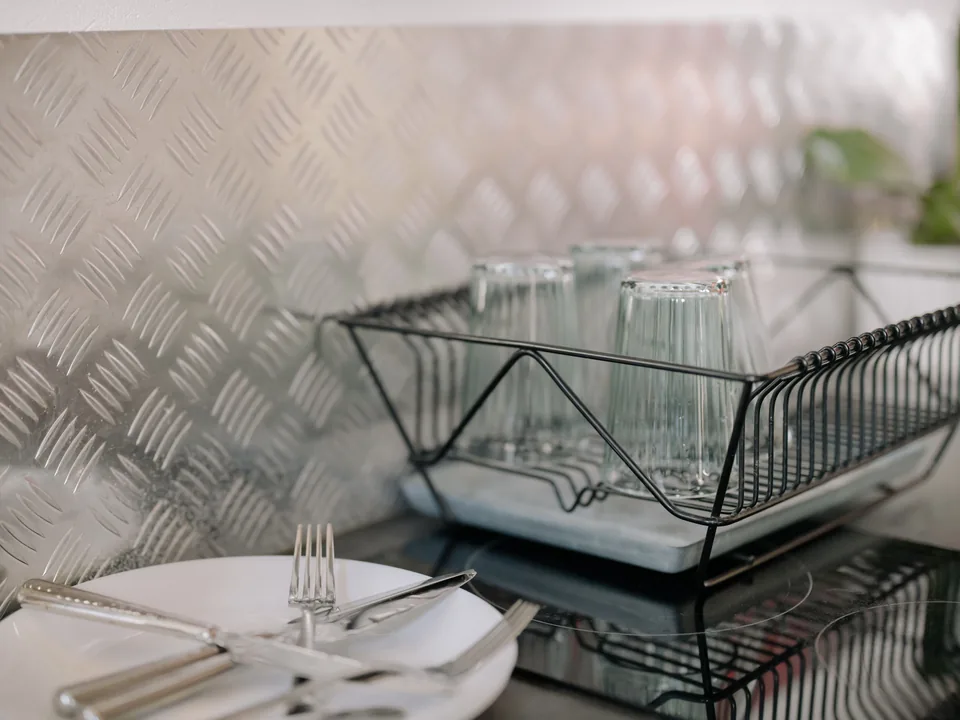
Check an expandable rack twice: once in its closed position and once at the extension you expect to use. A closed fit does not guarantee room for a dinner's worth of drying dishes.
The word “expandable” describes movement, not the direction of that movement on your counter. A maker may call the changing dimension depth even when you intend to turn that side along the sink. Keep the original axis labels until you have mapped the rack onto your space.
Two real examples, with the axes preserved
The following dimensions are the manufacturers' published inch values, checked October 10, 2026. They are rounded specifications, not our measurements. Match the exact model and variant before ordering.
| Model | Closed W × D × H | Extended W × D × H | Added depth* |
|---|---|---|---|
| Joseph Joseph Extend Slim Steel, gray SKU 6500035 | 9 × 12.2 × 6.3 in | 9 × 20.5 × 6.3 in | 8.3 in |
| Joseph Joseph Extend Steel, gray SKU 85153 | 14 × 12.25 × 6.5 in | 14 × 20.25 × 6.5 in | 8 in |
*Our subtraction of the maker's rounded inch values. The maker also supplies centimeter dimensions; rounding can matter in a tight space.
The Slim is narrower in the manufacturer's orientation, but its fully extended depth is slightly greater. “Slim” therefore does not mean shorter in every direction. This comparison establishes size differences only, not capacity, durability or drying performance.
Draw both footprints before shopping
- Measure usable space. Record width and depth after excluding the sink opening, unsupported counter edge and fixed obstacles.
- Mark the closed rectangle. Use a paper template or counter-safe removable tape. Label the side that expands.
- Add the extended rectangle. Check the travel between the two positions as well as the final outline. An obstacle can prevent opening even when the final rectangle looks clear.
- Map accessories. Locate the spout, cup holders and utensil pot. Do not assume every movable part is included in the headline dimensions.
- Check upward. Plates and cutting boards can rise above the empty frame. Leave room to lift them out beneath upper cabinets.
A closed pass can become an open fail
Suppose your usable area is 15 inches wide and 18 inches deep. In the listed orientation, the Slim's 9 × 12.2-inch closed footprint is inside that rectangle. Its 20.5-inch extended depth exceeds the available 18 inches by 2.5 inches, before adding any clearance.
Turning the fully extended rack 90 degrees would put 20.5 inches across the 15-inch width, so that orientation also fails. This is an original rectangular-fit example. It does not account for drainage or establish that the closed configuration is suitable for your dishes.
Can you leave it partly extended?
Check the exact model's operating instructions. Do not infer that every intermediate position is a supported working position or that a partial extension holds a particular load. If the maker permits the setting, measure the actual outside footprint there and recheck the spout and accessory positions.
Separate storage from use. A rack that closes neatly after the dishes are dry may still occupy too much working space during the day. Decide whether that temporary footprint blocks your usual prep area, a drawer, the faucet or sink access.
Next measurement
Compare the manufacturer-sourced rack dimensions, run both configurations through the Fit Finder, and finish with the dish-rack drainage checks. A calculator match is a starting point for checking the actual setup.
Sources and research limits
Manufacturer pages checked October 10, 2026. Numerical examples are illustrative calculations, not physical product tests. Missing reach and clearance values remain unverified.